Diablo I & Hellfire Strategy Guide
Diablo 1 & Hellfire Comprehensive Shopping Guide
A practical guide to targeting powerful equipment through vendor rules, ideal shopper levels, stat filtering, value anchors, and DevilutionX shop-breaking mechanics.
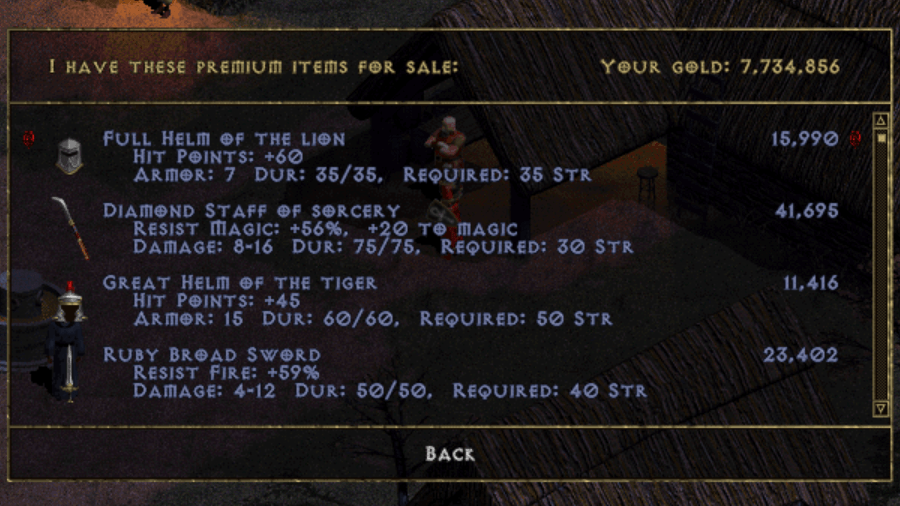
Shopping is one of the best ways to acquire powerful equipment in Diablo 1, and Hellfire adds enough extra mechanics that shopping can become a form of targeted item farming in its own right.
A good dungeon drop may take thousands of monster kills to find. Shops repeatedly generate equipment according to rules based on character level, vendor, item qlvl, affix qlvl, character stats, item value, and, in Hellfire, even the equipment you are already carrying.
Once you understand those rules, you can deliberately narrow the pool and greatly improve your chances of finding specific gear.
This guide focuses primarily on Hellfire and DevilutionX Hellfire, with Diablo differences noted where they matter.
- Primary Focus
- Hellfire / DevilutionX
- Griswold Premium Slots
- 15 in Hellfire
- Core Strategy
- Narrow the item pool
The three equipment vendors are:
- Griswold for weapons, armor, helms, shields, and uncharged staves in Hellfire
- Wirt for a single potentially exceptional magical item
- Adria for books and staves with spell charges
Pepin sells potions and, once available, elixirs, but he is not relevant to equipment shopping.
Why Shop Instead of Only Farming?
Dungeon farming and shopping work together.
Dungeon runs remain important for:
- Unique items
- Jewelry in multiplayer
- High-level magical drops
- Equipment unavailable from a particular merchant
- Gold to pay for expensive shop purchases
Shopping is especially useful when:
- You know the exact affixes you want
- The target can be generated by Griswold or Wirt
- You want a specific base item
- You want to target a narrow affix combination
- You want an affix that cannot normally drop in the dungeon
- You can manipulate the shop to eliminate large amounts of unwanted equipment
Some excellent endgame equipment is far more practical to obtain through shopping than by waiting for the dungeon to randomly generate it.
The important part is figuring out which vendor, shopper, character level, shop slots, and filtering setup give you the best odds.
Understanding qlvl and Item Creation Level
The most important number for practical shopping is qlvl, or quality level.
Base items, prefixes, suffixes, spells, and unique items all have qlvls.
Jarulf's Guide also uses the term ilvl, meaning item creation level. This is not the same concept as Diablo II's persistent hidden item level attached to an individual item.
In Diablo 1 and Hellfire shopping, it is better to think of ilvl as an intermediate number used while generating the shop inventory:
Character level + vendor/slot rules
→ item creation level
→ allowed qlvl ranges
For most shopping, you do not need to calculate the item creation level manually. What matters is the resulting range of base-item and affix qlvls available in each shop slot.
Our Hellfire Shop Qlvl Calculator handles this for you.
- qlvl
- The quality level assigned to base items, affixes, spells, and unique items.
- clvl
- The shopping character's current level.
- ilvl
- The temporary item creation level used to determine the qlvl ranges available to a shop slot.
Why the Correct Shopping Level Matters
Higher character level is not always better.
Some items have a limited shopping window. If your character level gets too high, the minimum qlvl allowed by the shop can rise enough that a low-level base item or low-level affix stops appearing entirely.
Examples include:
- Jester's Dagger/Club/Small Axe of Peril
- Topaz Shields of Blocking
- Merciless Long War Bow of Swiftness
For narrow targets, the goal is not simply to reach a level where the item becomes possible.
The goal is to find the character level where the largest useful number of shop slots can generate it.
Many targets have an ideal shopping level or a small range of ideal levels.
Using the Shopping Tools
There are a couple of good ways to research a target.
Jarulf + Shop Qlvl Calculator
If you prefer doing the research more manually, use Jarulf's Guide to look up:
- Base-item qlvl
- Prefix qlvl
- Suffix qlvl
- Affix values
- Valid item types
- Shop restrictions
- Item requirements
- Price information
Then use the Hellfire Shop Qlvl Calculator to determine where those qlvls fit into Griswold, Wirt, or Adria's available ranges.
In practice, all three resources work together well.
I often use the Premium Item Checker to confirm that something is possible, then use the Shop Qlvl Calculator to compare different character levels and determine exactly which shop slots I should be checking.
Griswold
Griswold is the main equipment merchant and generally the easiest vendor to farm.
He sells:
- Basic nonmagical equipment
- Premium magical equipment
The premium inventory is what matters for serious targeted shopping.
Diablo gives Griswold 6 premium slots.
Hellfire gives him 15 premium slots, making Griswold much more useful as an equipment source.
Shop Slots Matter
A target may be available:
- In all 15 slots
- Only in the first few slots
- Only in the later slots
- Across some middle range
This can dramatically change shopping efficiency.
For a narrow target, don't only ask:
"What level can this item appear?"
Also ask:
"Which level gives me the most useful Griswold slots?"
Getting a narrow item into slots 1–3 can be especially valuable because those slots generate the lowest-qlvl equipment in the shop.
Fresh Inventory vs. Replacement Items
One low-level Hellfire wrinkle is that the initial premium inventory and an item generated immediately after buying something are not always equivalent.
This matters most for very narrow low-level targets.
For something such as Jester's Dagger/Club of Peril, repeatedly restarting and checking a fresh Griswold inventory is more useful than assuming that buying the item in one of the first slots will give you another equivalent roll in its replacement slot.
Choosing a Shopping Character
Character level is only part of Hellfire shopping.
The shopper's class and current stats can also eliminate unwanted base items.
This is one of the biggest reasons Sorcerers are commonly used as dedicated shopping characters.
The Shopcerer
The Sorcerer's main advantage is not Teleport or Town Portal.
It is his extremely low maximum Strength:
45 Strength
Hellfire allows the shop to generate items with requirements up to roughly 120% of the greater of your natural maximum stat or current stat.
A Sorcerer held at 45 Strength therefore allows items requiring up to:
45 Strength × 1.2 = 54 Strength maximum requirementwhile blocking items with higher Strength requirements.
That can remove a huge amount of unwanted armor and weapon bases from the shop pool.
Controlling Strength
Equipment bonuses count toward your current Strength.
This matters when using the Veil of Steel, since it adds +15 Strength.
A normal max-Strength Sorcerer wearing the Veil would go from:
45 base Strength + 15 Veil of Steel = 60 current Strengthwhich allows much heavier equipment to enter the shop pool.
There are a couple of ways around this.
One is to build a dedicated Shopcerer with no more than 30 base Strength.
With Veil of Steel:
30 base Strength + 15 Veil of Steel = 45 current Strengthso you keep the same 54-Strength shop cutoff.
Another option is to keep cursed equipment of Trouble, which reduces all attributes.
Jewelry or one-handed weapons of Trouble can counteract unwanted Strength bonuses from shopping equipment such as Veil of Steel.
A carefully built Shopcerer can therefore combine:
- Low Strength for base-item filtering
- Veil of Steel for helm value filtering
- Expensive price anchors in other categories
without accidentally widening the equipment pool.
Sometimes You Want More Strength
Low Strength is not always desirable.
If you're targeting something such as a Tower Shield, you need enough Strength for the shop to allow the base item.
A Tower Shield requires 60 Strength, so setting a Sorcerer's Strength to exactly 50 works nicely:
50 Strength × 1.2 = 60 Strength maximum requirementThat allows Tower Shields while still excluding equipment requiring more than 60 Strength.
The same principle works at both Griswold and Wirt.
Barbarian Shopping
The Barbarian can also be useful for certain targets.
He is not useful when you want to eliminate high-Strength equipment, but that becomes an advantage when the item you want has a high Strength requirement anyway.
His low Dexterity can also help eliminate certain bows.
Barbarians are particularly useful for armor or heavy-weapon shopping where restricting Strength would only remove the equipment you're looking for.
Back Up Shopping Characters
Instead of worrying about accidentally leveling a shopper past an important breakpoint, I prefer making backup copies of shopping characters at useful levels.
That lets you keep things such as:
- Level 9 Jester shopper
- Level 12 Blocking-shield shopper
- Level 20–22 shield shoppers
- Level 30 endgame shoppers
and simply use the appropriate copy for whatever you're currently hunting.
Hellfire's 80% Value Rule
Hellfire adds one of the most useful shopping mechanics in the game.
When Griswold generates premium equipment, he tries to make the item worth more than 80% of the most expensive item of the same type that you already possess.
This is checked separately for:
- Armor
- Axes
- Bows
- Clubs
- Helms
- Shields
- Staves
- Swords
- Rings
- Amulets
The item can be equipped or simply carried in your inventory.
This means equipment can remain useful even when you would never fight with it.
It becomes shopping gear.
Building Better Anchors
You do not need ideal shopping anchors immediately.
You can gradually work your way upward.
- Carry the most expensive item you currently own in a category.
- Let the 80% rule bias the shop toward more expensive equipment.
- Buy or find a more expensive item.
- Replace your old anchor.
- Repeat.
Over time, you can build a dedicated shopping kit that eliminates a large amount of lower-value junk before it ever reaches the shop inventory.
Armor Anchor: Demonspike Coat
Demonspike Coat is one of the strongest possible shopping anchors because its value is over 250,000 gold.
Its 80% threshold is therefore higher than Hellfire's normal 200,000-gold shop limit.
Under the normal rules, no newly generated armor can simultaneously:
- Be worth more than 80% of Demonspike Coat
- Stay under the normal shop price ceiling
That forces Griswold's armor generation into its retry/fallback behavior.
Even if you never wear Demonspike Coat, it can be extremely valuable on a shopping character.
Helm Anchor: Veil of Steel
The Veil of Steel is an excellent helm anchor.
Its high value eliminates most cheap helmet combinations from satisfying the 80% requirement.
It is also much easier to obtain consistently than many theoretical high-value magical helms because it is a quest reward.
Just remember that its +15 Strength can interfere with Shopcerer filtering.
Shield Anchors
One of the most valuable possible shield anchors is an:
Emerald Gothic Shield of the Tiger
This is more valuable than an Emerald Gothic Shield of Ages.
The reason you sometimes see Emerald Gothic Shield of Ages discussed in relation to Wirt is not because Ages is expensive. Ages is simply the only suffix Wirt can generate alongside Emerald on a Gothic Shield under the normal affix-generation rules.
An Emerald Gothic Shield of the Tiger is a much better price anchor, but it cannot normally be shopped. Emerald's qlvl pushes it beyond normal Griswold generation, so this kind of shield generally has to come from sufficiently high-level dungeon drops.
Even an Emerald Gothic Shield without the ideal suffix can make an excellent shopping anchor.
Weapon Anchors
For weapon categories, the most useful anchors are usually expensive combinations such as King's or Emerald weapons of the Heavens.
Examples include:
- King's/Emerald Great Sword of the Heavens
- King's/Emerald Great Axe of the Heavens
- King's/Emerald Maul of the Heavens
- Emerald Long War Bow of the Heavens
Larger base weapons are generally preferable when the goal is simply maximizing price.
Staff Anchors
Very expensive staves can exceed 250,000 gold.
A King's Staff carrying expensive spell charges such as Blood Star is one possible route.
There are several staff combinations capable of becoming extremely valuable, although the best ones usually have to be found in the dungeon or obtained through Wirt.
Item Value vs. Resale Value
When Griswold buys equipment from you, he normally offers one quarter of its actual item value.
So an item worth:
126,375 gold
will show a resale value around:
31,593 gold
That makes resale price a convenient way to estimate an anchor's real value.
Alternatively, enter the item's exact stats into the Hellfire Item Price Calculator.
The calculator is especially useful when planning around theoretical equipment you do not own yet.
Shop Price Limits
A magical item can satisfy all of the qlvl and affix rules and still fail to appear because its price is too high.
Hellfire normally caps town-generated items at 200,000 gold in underlying item value.
Wirt applies his own pricing modifier afterward, which is why his displayed prices differ.
The Hellfire Item Price Calculator reports when a theoretical item exceeds the normal shop limit.
That doesn't necessarily make the item absolutely unobtainable in DevilutionX, but it means you are no longer doing normal shopping.
You are trying to break the shop's normal generation rules.
Shop Breaking in DevilutionX
DevilutionX's shop generators do not retry forever.
If the game keeps rejecting generated items because they violate the normal filters, it eventually gives up.
That creates a small loophole for equipment that should normally fail because of price, requirements, or other restrictions.
Griswold
Hellfire Griswold gets 150 attempts to find an item that satisfies his normal filters.
If those attempts fail, the final fallback can violate conditions that would normally cause the item to be rejected.
Wirt
Wirt has two important retry thresholds.
After 200 failed attempts, his normal class-based item-type restrictions are relaxed.
The other filters continue longer.
At 250 attempts, Wirt can finally fall through the broader restrictions involving things such as:
- Item price
- Stat requirements
- The 80% value rule
This is the mechanic behind extreme targets such as Godly Plate of the Whale.
You are deliberately trying to make Wirt reject enough items that the generator finally accepts something that would normally be filtered out.
This is vastly slower than shopping for equipment that fits the normal rules, but it makes a handful of otherwise unavailable items technically obtainable.
Important Shopping Targets
The following are some useful targets and example shopping setups.
They are not the only good equipment in the game, but they show how character level, stats, slots, price anchors, and vendor rules can all be combined.
Armor
Awesome Full Plate Mail of Harmony
For most characters capable of wearing it, one of the best general-purpose magical armors is:
Awesome Full Plate Mail of Harmony
Awesome provides high Armor Class while Harmony provides fastest hit recovery.
A plain Awesome Full Plate Mail can be perfectly good while developing a character, but Harmony is generally the suffix to shoot for long-term.
Other desirable or situational suffixes include:
- of Stars
- of Sorcery
- of the Lion
- of the Mammoth
- of the Whale
- of Osmosis
These all have uses, but they generally do not replace Harmony as the standard target.
Less desirable but still potentially useful suffixes include:
- of Deflection
- of Giants
- of Precision
- of Vigor
Recommended Awesome FPM Shopping Setup
Use a:
Level 30 Barbarian with no more than 55 Dexterity
Carry the most expensive practical equipment you can in every category.
For armor, use an anchor worth approximately:
198,400 gold
Resale: approximately 49,600
This eliminates most cheaper armor while still leaving the main targets available.
With this setup, Awesome Full Plate Mail of Harmony can appear in any Griswold premium slot.
It also leaves other useful combinations available, including things such as:
- Awesome Full Plate Mail of the Tiger
- Awesome Full Plate Mail of the Lion
If you also want Awesome Full Plate Mail of Sorcery to remain eligible, lower the armor anchor to around:
184,275 gold
Resale: approximately 46,068
Awesome Full Plate Mail of Stars
Awesome Full Plate Mail of Stars always exceeds the normal 200,000-gold shop limit.
It could theoretically be forced through shop fallback behavior, but it is not really worth going through that much trouble for.
A Saintly Full Plate Mail of Stars, however, is normally shoppable and is a perfectly valid alternative.
It can be especially useful if your jewelry is not yet great and you're willing to get fastest hit recovery from another slot such as:
- Jewelry of Harmony
- A helm of Harmony
Mammoth, Whale, and Osmosis Armor
High-life armor such as:
- Godly/Holy/Awesome Plate of the Mammoth
- Godly/Holy/Awesome Plate of the Whale
can become too expensive for ordinary shopping.
of Osmosis is also a high-level Wirt-only suffix and can produce similarly difficult Full Plate Mail combinations.
These are more niche than Awesome FPM of Harmony and generally require Wirt rather than ordinary Griswold shopping.
Godly Plate of the Whale
Godly Plate of the Whale, usually shortened to GPoW, is basically the holy grail of Hellfire shopping.
It is not something you normally roll at Wirt.
The strategy is to deliberately make Wirt fail his generation checks enough times that his fallback behavior has a chance to let the item through.
GPoW Shopping Setup
A practical setup is:
- Sorcerer
- At least clvl 30
- No more than 45 Strength
- The most expensive practical equipment of every item type carried or equipped
The low Sorcerer Strength eliminates large amounts of unwanted equipment while the expensive anchors make Wirt reject as much cheap gear as possible.
The goal is to force Wirt into the 250-attempt fallback as often as possible.
Even with the shop optimized, the odds are extremely low.
Very few players have ever forced one.
Shields
Obsidian Tower Shield of the Tiger
For Warriors, who already have natural Fast Block, one of the best normal Griswold targets is:
Obsidian Tower Shield of the Tiger
A perfect example would have:
- +40% Resist All
- +50 Life
- 20 base Armor Class
Obsidian Tower Shield of the Wolf is also very good.
Resistance Roll
I would generally avoid buying one with less than about 35% Resist All.
The reason is that a stronger Obsidian roll makes it much easier to reach maximum resistances with only one other major resistance item.
Ideally, you want the roll as close to 40% as possible.
Recommended Shopping Setup
Use a Sorcerer with approximately 50 Strength.
That allows the 60-Strength Tower Shield requirement while continuing to exclude heavier equipment.
A shield anchor around:
55,612 gold
Resale: approximately 13,903
is useful for eliminating many lower-value shields and tends to filter out weaker Obsidian rolls, although a shield with weaker resistances and a very high Life roll can occasionally still be expensive enough to pass.
If you're specifically hunting a perfect Obsidian Tower Shield of the Tiger, an anchor around:
76,312 gold
Resale: approximately 19,078
can eliminate anything cheaper than the perfect target.
The combination becomes available from Griswold around clvl 22+.
Emerald Tower Shield of the Tiger
An even stronger resistance version is:
Emerald Tower Shield of the Tiger
This can be targeted from Wirt around:
clvl 20–21
A Sorcerer with exactly 50 Strength is again a very good shopper because it allows the 60-Strength Tower Shield while excluding anything requiring more Strength.
The perfect shield would have:
- +50% Resist All
- +50 Life
- 20 base Armor Class
This is one of the best examples of using both the shopper's stats and Wirt's affix access to target an item that Griswold cannot normally provide.
Resistance Shields of Blocking
Characters without natural Fast Block often want a magical shield carrying of Blocking.
Useful resistance prefixes include:
- Topaz
- Pearl
- Crimson
- Azure
A good general shopping setup is:
Level 12 Sorcerer with no more than 45 Strength
Check Griswold's first six premium slots.
The low Strength helps remove unwanted heavier equipment, although price anchoring is already very effective at this level if you have sufficiently expensive shopping gear.
King's Swords
For conventional sword users, common high-end targets include:
- King's Bastard Sword of Haste
- King's Bastard Sword of Speed
- King's Bastard Sword of Vampires
- King's Bastard Sword of Blood
A Broad Sword is also perfectly usable if the rolls are good, but Bastard Sword is generally preferred.
Haste is usually the first choice for raw attack speed.
Speed is extremely close and remains an excellent weapon.
Vampires and Blood trade attack speed for mana or life recovery.
Recommended Shopping Setup
Use a:
Level 30 Sorcerer with no more than 45 Strength
These King's Sword combinations can appear in any of Griswold's 15 premium slots.
Carry a sword worth around:
97,625 gold
Resale: approximately 24,406
and use the most expensive practical anchors you own in the other equipment categories.
This filters out large amounts of unrelated cheap equipment without widening the high-Strength base pool.
King's Great Axes
For Barbarians, common endgame magical axe targets include:
- King's Great Axe of Haste
- King's Great Axe of Speed
- King's Great Axe of Blood
- King's Great Axe of Vampires
Recommended Shopping Setup
Use either:
- Level 30 Barbarian
- Level 30 Sorcerer with at least 67 Strength
The combination can appear in any Griswold premium slot.
A strong axe-category anchor is worth around:
177,000 gold
Resale: approximately 44,250
Carry the most expensive equipment you can in the other categories as well.
King's War Staff
For the Monk, the main magical staff target is straightforward:
- King's War Staff of Haste
- King's War Staff of Speed
The Monk attacks very quickly with staves, can block while using them, and gets his adjacent quarter-damage attack with staves.
Blood and Vampires are not available on staves, leaving Haste/Speed as the obvious offensive suffixes.
Recommended Shopping Setup
Use a:
Level 30 Sorcerer with 25–45 Strength
Twenty-five Strength is enough for the War Staff while remaining below the Sorcerer's natural 45-Strength maximum.
The target can appear in all 15 Griswold premium slots.
A good staff anchor is worth around:
126,375 gold
Resale: approximately 31,593
Jester's Weapons of Peril
Hellfire adds one of the stranger physical weapon combinations in the game:
- Jester's Dagger of Peril
- Jester's Club of Peril
- Jester's Small Axe of Peril
Jester's causes highly variable outgoing damage, while Peril doubles damage dealt and also causes damage to the user.
Because the returned Peril damage is based on weapon damage, low base weapon damage is actually desirable.
That makes Dagger, Club, and Small Axe ideal rather than inferior versions of larger weapons.
Recommended Shopping Setup
Use a:
Level 9 Sorcerer
On a fresh Griswold premium inventory:
- Jester's Dagger of Peril: slots 1–3
- Jester's Club of Peril: slots 1–3
- Jester's Small Axe of Peril: slots 1–14
The Small Axe cannot appear in slot 15 because that slot's minimum base qlvl is already too high at level 9.
This is about as optimized as the target gets.
Dagger and Club have qlvl 1 bases, while Jester's requires qlvl 7 and Peril requires qlvl 5. At clvl 9, Griswold's first three slots reach exactly the range necessary to combine those low-level bases with the higher-level Jester prefix.
The Small Axe has a qlvl 2 base, allowing it to survive through nearly the entire shop.
This is a good example of an item where leveling the shopper higher would actually make the desired low-qlvl bases disappear.
Rogue Bows
Bow shopping differs substantially between Diablo and Hellfire.
Diablo: Massive Long War Bow of Swiftness
One of the classic Diablo Rogue weapons is:
Massive Long War Bow of Swiftness
Diablo Shopping
Use approximately:
clvl 21
and check Griswold's first four premium slots.
Hellfire Shopping
In Hellfire, the same bow is best targeted around:
clvl 22
and can appear in Griswold's first six premium slots.
The bow itself is not particularly useful as an endgame Hellfire weapon because Swiftness no longer increases the Rogue's firing animation. In Hellfire it increases arrow travel speed instead.
However, DevilutionX Hellfire characters can be converted to Diablo by changing a copied save file from:
Hellfire save: .hsv
Diablo save:  .sv
So it is possible to shop the bow under Hellfire's more generous 15-slot Griswold system and then transfer a copy of the character to Diablo.
Hellfire Rogue Bows
Hellfire's Oils change what makes a good bow.
Why Short War Bow?
For a heavily developed magical bow, Short War Bow is usually preferable to Long War Bow because of its higher minimum damage.
Oil of Sharpness can increase maximum damage until the difference between minimum and maximum damage reaches 30.
That means:
Short War Bow: 4–34
Long War Bow:  1–31
after fully developing their maximum damage.
The Short War Bow therefore ends up with significantly better total physical damage.
High-End Prefixes
Strong Hellfire bow prefixes include:
- Merciless
- Emerald
- Strange
- Obsidian
Merciless is the main raw-damage option.
Emerald is the best Resist All option.
Obsidian is weaker than Emerald but remains perfectly serviceable.
Strange can be useful when additional chance to hit is needed.
Reasonable earlier damage prefixes include:
- Ruthless
- Savage
- Massive
You do not need to wait for a perfect Merciless bow before using a good damage bow.
Useful Suffixes
A premier damage-oriented target is:
Merciless Short War Bow of the Heavens
A resistance-oriented alternative is:
Emerald Short War Bow of the Heavens
Other useful suffixes include:
- of Burning
- of Thunder
for elemental damage.
Temporary bows can also be useful with:
- of Stars
- of Perfection
- of Precision
- of Sorcery
Those can make perfectly good weapons while progressing, but I generally would not spend large numbers of harder-to-find Oils developing a bow that I already expect to replace.
Price Limits
Do not blindly apply every old Diablo/Hellfire price example to DevilutionX.
For example, old references sometimes use Merciless Long War Bow of the Heavens as an example of an item that cannot be sold because of its price.
Under DevilutionX Hellfire's pricing and 200,000-gold shop limit, Merciless bows of the Heavens can fit within the normal rules.
Use the Hellfire Item Price Calculator rather than relying on an old example.
If the calculator reports that an item exceeds the normal shop limit, you can still theoretically attempt to force it through DevilutionX fallback behavior, but the odds become dramatically worse.
Wirt
Wirt is simultaneously one of the most powerful and most annoying merchants in the game.
He:
- Shows one item at a time
- Charges 50 gold just to see it
- Is located far away from the main town shopping area
- Has Hellfire class-based item restrictions
- Requires restarting or another valid refresh condition to generate another useful roll
For practical repeated Wirt farming, the normal routine is basically:
Start game → run across town → pay Wirt → check item → restartThis is much slower than Griswold shopping.
Wirt is primarily worth the effort when the item you're hunting either:
- Uses affixes Griswold cannot generate
- Uses a prefix/suffix combination Griswold cannot generate
- Requires advanced shop breaking
Wirt's qlvl Rules
Wirt can generate base items with qlvl:
Base-item qlvl: 1 through clvl
Affix qlvl:     clvl through 2 × clvl
Once the lower end rises above 25, it is capped back at 25.
Wirt's maximum affix qlvl is 60.
This gives him access to high-level affixes that Griswold can never sell.
Examples include:
- Godly
- Merciless
- Strange
- Whale
- Slaughter
- Osmosis
and other qlvl 30+ affixes.
Hellfire Wirt Class Restrictions
Wirt restricts certain item categories depending on the shopper's class.
| Class | Wirt normally will not sell |
|---|---|
| Warrior | Bows, Staves |
| Rogue | Axes, Clubs, Swords, Staves, Shields |
| Sorcerer | Axes, Clubs, Bows, Staves |
| Monk | Clubs, Bows, Shields, Medium Armor |
| Bard | Axes, Clubs, Staves |
| Barbarian | Bows, Staves |
Shopper class therefore matters at Wirt even before stat filtering is considered.
In some cases, these restrictions are useful because they eliminate unwanted item types.
At the 200-attempt shop-breaking threshold, these class restrictions stop being enforced.
Why Wirt Loves "of Ages"
High-level Wirt inventories often appear flooded with of Ages.
That is not because Ages is particularly valuable.
At high Wirt qlvls there simply are not many suffixes that:
- Can occur on the item
- Fit the qlvl relationship
- Stay inside normal price restrictions
Ages happens to survive those rules surprisingly often.
The same issue explains why an Emerald Gothic Shield of Ages is a normal Wirt possibility even though Ages itself adds very little monetary value.
Adria
Adria works slightly differently between Diablo and Hellfire.
Hellfire
In Hellfire, Adria only sells staves containing spell charges.
Griswold sells the opposite type: magical staves without spell charges.
Wirt can sell staves both with and without spell charges depending on his generation rules.
Diablo
In Diablo:
- Griswold does not sell staves
- Adria can sell charged and uncharged staves
This is one of the relatively small but important vendor differences between Diablo and Hellfire.
Adria's Limits
Adria's maximum item creation level is 16.
This means:
- Base items cap at qlvl 16
- Spells on books or charged staves cap at qlvl 16
- Staff prefixes can reach qlvl 32
One important consequence:
Staves of Magi cannot spawn at Adria.
Magi is too high-level for her spell-generation limit.
If you want a staff carrying Magi charges, shop Wirt.
Check Adria Often
Adria refreshes whenever you return to town from the dungeon.
That makes her worth checking constantly during normal play for:
- Spellbooks
- Useful charged staves
- Elixirs once available
- Mana supplies
Once your character is high enough for elixirs, every trip back to town gives you another chance at permanent stat progression.
Jewelry and Multiplayer
Griswold and Wirt only sell jewelry in single player.
In multiplayer, rings and amulets must be found.
That makes dungeon farming unavoidable for many of the strongest jewelry combinations, including:
- Obsidian Jewelry of the Zodiac
- Dragon's Jewelry of the Zodiac
- Dragon's Jewelry of Wizardry
- Gold Jewelry of the Heavens
- Gold Jewelry of Perfection
- High single-resistance jewelry
- Jewelry of the Dark
This is one reason Normal Hell farming remains useful even for players who do a large amount of targeted shopping.
Shops can solve your weapons, armor, helms, and shields.
Your jewelry is still largely a dungeon problem.
Oils and Shop Equipment
Hellfire Oils change how you evaluate final equipment, but they do not mean every near-miss is worth spending Oils on.
Oils are valuable enough that I generally save them for equipment I expect to keep.
Any excellent permanent item can be worth developing.
Weapons in particular can often benefit from Oils of Sharpness.
Oils of Accuracy are more situational because many top magical melee weapons already use King's, which naturally gives more To Hit than Accuracy Oils can add.
Accuracy Oils become more valuable on strong weapons that lack their own To Hit, such as Civerb's Cudgel.
Durability Oils and Hidden Shrines can eventually be used to push good equipment toward 255 durability and indestructibility.
The main rule is simple:
Gold Management
High-end shopping requires a lot of gold.
Even when the individual refreshes are cheap, the final item may cost close to the shop maximum.
Good gold sources include:
- Selling magical equipment from Hell runs
- Warlord of Blood runs
- Weapon and Armor Racks
- Lazarus runs
- Normal high-level dungeon farming
Warlord runs are particularly convenient in DevilutionX when multiplayer quests are enabled and quest randomization is disabled.
The Warlord room provides:
- A guaranteed boss drop
- 2 Armor Racks
- 6 Weapon Racks
Most of the equipment will be junk, but junk sells.
A Practical Targeted Shopping Workflow
When casually playing, there is no reason to calculate every Griswold visit.
Just check the shops when you return to town and buy anything obviously useful.
Targeted shopping is different.
If you're hunting a specific high-end item:
- Choose the exact base item.
- Choose the exact prefix and suffix.
- Check the Premium Item Checker to make sure the combination is valid.
- Use Jarulf's Guide for detailed affix and item information when needed.
- Use the Shop Qlvl Calculator to find the best shopper level and Griswold slots.
- Use the Hellfire Item Price Calculator if the item is expensive.
- Choose the shopper class that removes the most unwanted equipment without removing your target.
- Set the shopper's stats carefully.
- Carry the best price anchors you have for every relevant item type.
- Back up the shopper at useful character levels.
- Check only the shop slots that can actually generate the target.
- Refresh as efficiently as possible.
Once those variables are controlled, shopping becomes a form of targeted item farming rather than simply checking Griswold and hoping he happens to have something good.
Shopping and Dungeon Farming Work Together
Shopping does not replace dungeon farming.
Use Griswold and Wirt when their generation rules make a target practical.
Farm the dungeon for:
- Jewelry in multiplayer
- Unique items
- High-level boss drops
- Equipment the shops cannot normally generate
- Better shopping anchors
- Gold
Check Adria throughout the process for books, charged staves, and elixirs.
Hellfire's shopping system rewards understanding exactly what the game is allowed to generate and then removing as much of the unwanted pool as possible.
Understanding the shop rules lets you narrow the possible results substantially, which makes targeted shopping much more efficient than blindly checking vendors and hoping for the best.